From Emergency to Prediction

Anticipating health crises through weak-signal detection, data integration and AI-driven decision support.

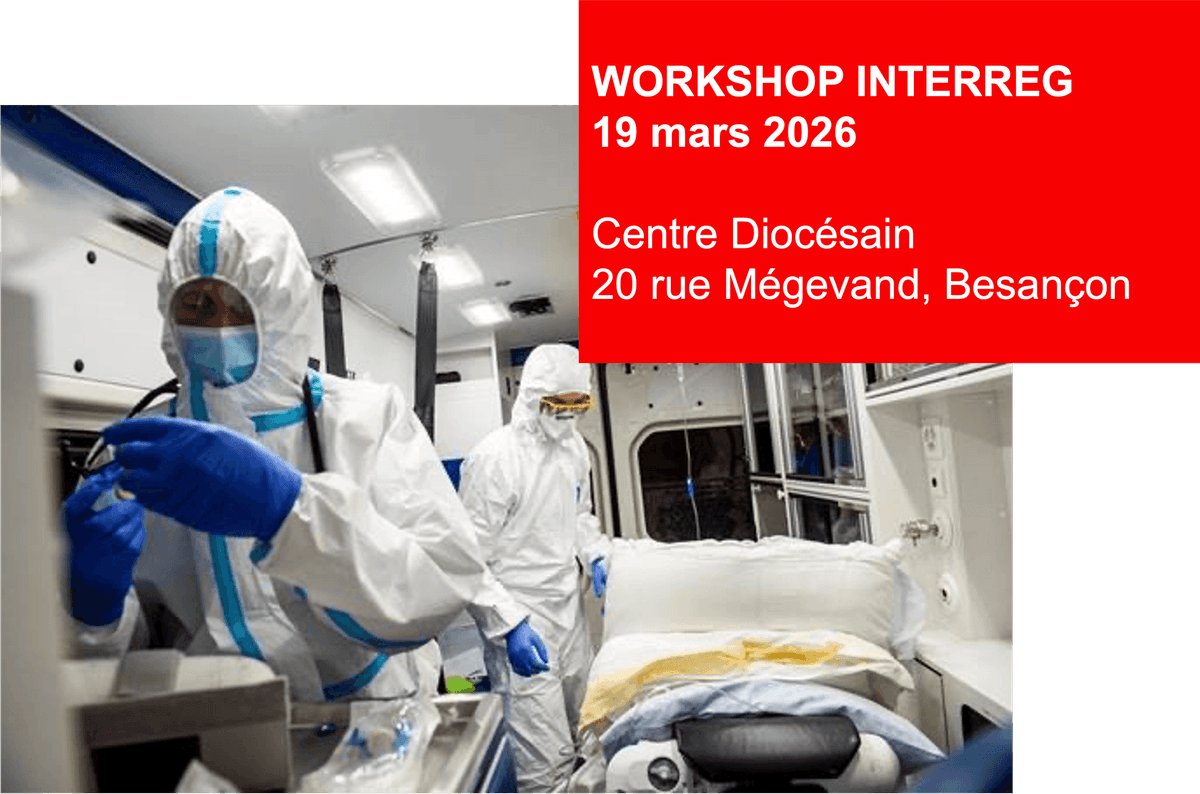
Cross-Border Workshop · 19 March 2026 · Besançon
Universitätsspital_Lausanne_CHUV_logo.svg.png20220404125738!Logo_CHU_Besançon.jpgLOGO_UMLP-768x307.pngLogo-couleur_700.jpg2022_01_RBFC_INTERREG_LOGO-RGB-ss-fd.pngHôpitaux_universitaires_de_Genève_2015_logo.svgHOPITAL_NORD_FRANCHE_COMTE_LOGO.pngSAMS-LOGO-RVB-Transparent.pngheigvd.pngars.jpgimages (1).pngimages.pnglogo_am_1200x630.pngconfederation.svg

Why now?

Recent crises, from COVID-19 to climate-driven events, have revealed a critical need:

healthcare systems must be able to anticipate, not only react.

Hospitals, emergency services, public health agencies and decision-makers all face increasingly complex situations requiring faster detection, better information flows, and more robust preparation.

This workshop brings together French and Swiss experts to explore how early indicators, operational feedback and AI-based tools can strengthen crisis anticipation, coordination and strategic planning.

Key Themes

Weak-signal detection

How clinical, operational and environmental data can support early identification of exceptional health situations.

charts.svg

Cross-border crisis coordination

Insights from French and Swiss emergency networks, including lessons learned from recent crises.

web-app.svg

Resource optimisation & modelling

Approaches to planning, dimensioning and allocating emergency resources under high uncertainty.
web-app.svg

AI for preparedness and real-time decision-making

Opportunities, limitations and ethical considerations of predictive models in crisis management.

chat.svg

GESICA project insights

Presentation of the first results of ongoing work packages.

chat.svg

About GESICA ?

GESICA (Gestion des Situations de Crises Sanitaires) is an Interreg France–Switzerland project bringing together university hospitals, emergency services, public health institutions, research teams and industry partners.

Over 36 months, the project aims to develop innovative methods and tools combining multi-source data, weak-signal analytics and predictive modelling to support early detection and improve decision-making during health crises.

Full Programme of the day

Thursday, 19 March 2026

Centre Diocésain, 20 rue Mégevand, Besançon

Reception begins at 8:15 am

Who should attend?

This workshop is intended for:

Healthcare institutions and hospital leadership

Emergency departments, crisis units, strategic planning teams.

Emergency professionals

Physicians, nurses, dispatch centres (Centre 15, 144), prehospital services and EMS coordinators.

Public authorities and health agencies

ARS, cantonal health services, public health decision-makers and crisis managers.

Researchers and academic teams

Specialists in AI, modelling, epidemiology, operational research and health systems engineering.

Industry partners

Companies developing medical technologies, digital health solutions, AI tools or crisis management platforms.

Practical information

In Besançon on March 19th 2026, from 9:00 to 17:00

Centre diocésain - Espace Grammont

20 Rue Megevand, 25000 Besançon

Free admission but required registratoin due to limited capacity

View on Google Maps
20 Rue Mégevand, 25000 Besançon, France

Centre Diocésain

©Mapbox ©OpenStreetMap

Registration is now closed.

See you on Thursday, March 19 for the workshop!

FAQ

Frequently asked questions answered

What is the date and location of the workshop?

The workshop will take place at the Maison des Sciences Humaines et Environementales on 19 March 2026 in Besançon, France.

Is the event free of charge?

Yes. Participation is free for all invited institutions, partners and contributors, but registration is mandatory due to limited seating.

Who can register?

The workshop is intended for healthcare institutions, emergency professionals, public authorities, academic teams and industry partners involved in crisis management or health innovation.

Will the workshop be held in English or French?

The workshop will be conducted in French. Simultaneous translation is not planned.

Will the workshop be recorded or livestreamed?

No livestream is planned.

Will I receive the slides or materials after the event?

Yes. Speakers who agree will make their slides available to participants after the workshop.

Are meals provided during the day?

Yes. Coffee breaks and a light lunch are included for all registered participants.

How can I modify or cancel my registration?

You can update your information or cancel your attendance by contacting the organising team via the registration confirmation email.

Is travel or accommodation covered?

Travel and accommodation are not covered by the organisers unless stated otherwise for specific invited speakers.

Will parking be available?

Limited parking spots will be available near the venue. We encourage public transport when possible.

Which organisations are involved in the workshop?

The event is organised within the GESICA Interreg France–Switzerland project, with participation from university hospitals, emergency services, public authorities, academic partners and industry contributors.

Do I need to prepare anything before attending?

No preparation is required. Background information on the GESICA project will be provided during the workshop and on the event page.

Find an accomodation

Here is a short list of hotels near the workshop location.

Hôtel Le Sauvage (4★)

6 rue du Chapitre, 25000 Besançon

Hôtel du Nord (2★)

8 rue Moncey, 25000 Besançon

Hôtel Vauban (3★)

9 quai Vauban, 25000 Besançon

Hôtel de Paris (3★)

33 rue des Granges, 25000 Besançon

Best Western Citadelle (3★)

13 rue du Général Lecourbe, 25000 Besançon

Mercure Besançon Parc Micaud (4★)

3 avenue Édouard Droz, 25000 Besançon

Ibis Besançon Centre Ville (3★)

21 rue Gambetta, 25000 Besançon

Ibis Besançon La City (3★)

1 avenue Lou Blazer, 25000 Besançon

Hôtel Victor Hugo & Spa (4★)

7 avenue Foch, 25000 Besançon

Cookie Settings
This website uses cookies

Cookie Settings

We use cookies to improve user experience. Choose what cookie categories you allow us to use. You can read more about our Cookie Policy by clicking on Cookie Policy below.

These cookies enable strictly necessary cookies for security, language support and verification of identity. These cookies can’t be disabled.

These cookies collect data to remember choices users make to improve and give a better user experience. Disabling can cause some parts of the site to not work properly.

These cookies help us to understand how visitors interact with our website, help us measure and analyze traffic to improve our service.

These cookies help us to better deliver marketing content and customized ads.